 John
Five roads into the mold. They do not lead to the same part.
Ask how a carbon fiber part was made and you will usually get a shrug or a marketing word. But the manufacturing method is arguably the single biggest determinant of what you are holding. Its weight, its strength, its price, and how it will age. There are five main ways carbon parts come into the world, and they are not interchangeable. Here is the field guide.
1. Wet Layup: the Garage Method
The oldest and simplest: dry fabric in a mold, resin brushed or poured on by hand, air worked out with rollers. It needs almost no equipment, which is why it is everywhere in the budget market. The weaknesses are consistency and resin content. Hand work means resin-rich spots, and without vacuum pressure, voids are common. Wet layup has its place for low-stress parts at low prices, but it is the bottom of the quality ladder, and the dry carbon vs wet carbon explainer is named after exactly this gap.
2. Vacuum Bagging: Wet Layup With Discipline
Take a wet layup, seal it under a plastic film, and pull a vacuum. Atmospheric pressure, about a ton per square foot, squeezes the laminate against the mold, pressing out excess resin and trapped air. Same materials as wet layup, dramatically better result: lighter, more consistent, fewer voids. This is the sweet spot for small shops making quality parts, and a huge step up for very little equipment cost.
3. Resin Infusion: Let the Vacuum Do the Work
Infusion flips the logic. Dry fabric goes in the mold, the whole stack is sealed under vacuum, and resin is drawn in through ports by the vacuum itself, flowing through the fabric like tide through a marsh. Done well, it produces excellent fiber-to-resin ratios and beautiful consistency across large panels. Done carelessly, it produces dry spots the size of your hand. It rewards process control, and it scales from one-off parts to serious production.
4. Prepreg and Autoclave: the Aerospace Standard
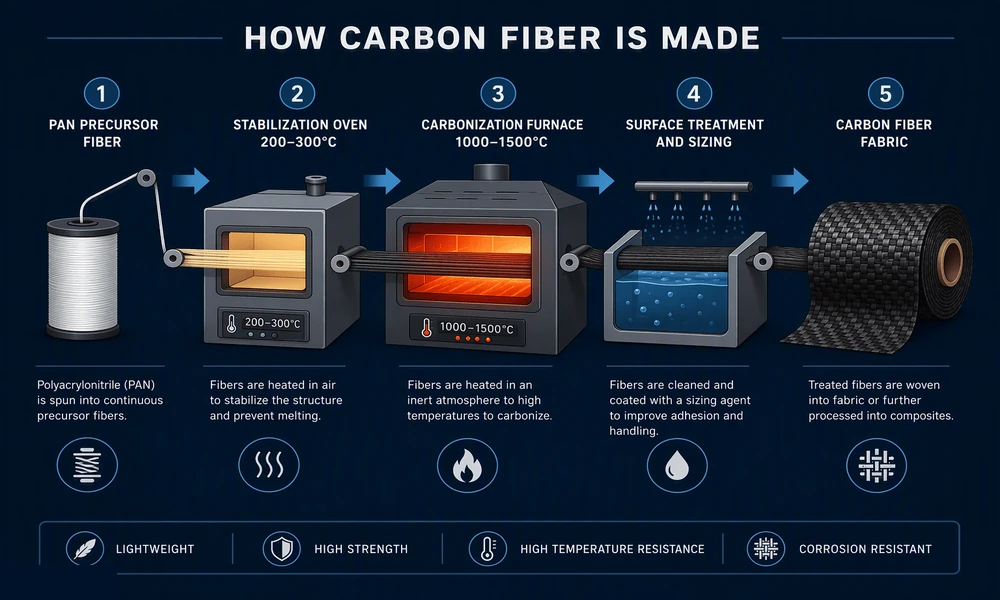
Prepreg is fabric that comes pre-impregnated with precisely measured resin, stored frozen until use. It is laid into the mold, vacuum bagged, and cured in an autoclave. Essentially a giant pressure oven that cooks the part under heat and several atmospheres of pressure. The result is the gold standard: minimum voids, exact resin content, maximum strength-to-weight. This is how Formula 1 monocoques and aircraft panels are made. It is also why the equipment budget has six or seven figures. The carbon fiber manufacturing process covers where each method fits in a professional operation.
5. Compression Molding: Speed and Shape
The industrial route: a measured charge of material, often chopped fiber in resin, the family that includes forged carbon, is placed in a matched metal mold and squeezed shut under high pressure and heat. Cycle times drop to minutes, complex three-dimensional shapes become easy, and consistency is superb. The trade-off is tooling cost and, with chopped fiber, lower directional strength than continuous weave. Perfect for high-volume parts and complex geometry; the wrong tool for a hood that lives on weave looks.
The Hybrid Approaches Nobody Advertises
Real factories rarely live at the pure extremes. A common professional recipe combines methods: a prepreg surface ply for perfect weave appearance and low void content at the visible face, with infused or vacuum-bagged backing plies for cost control and thickness. Other shops infusion-cure a part and then post-cure it in an oven to raise the resin’s temperature resistance. These hybrids are legitimate engineering, and they complicate the dry-versus-wet shorthand. A part can be genuinely excellent without being pure prepreg, and genuinely mediocre despite the label. Process honesty from the seller matters more than process purity.
Matching the Method to the Part
Different parts deserve different methods. A flat interior trim panel can be perfectly served by vacuum bagging; a structural strut brace wants prepreg; a complex intake elbow with compound curves in every direction is compression molding’s home turf. Trouble starts when the method and the part are mismatched. Usually a budget method stretched beyond its brief to hit a price point. The part does not know what it cost. It only knows how it was made.
What the Method Tells You
- Wet layup: low price, inspect hard, expect resin weight.
- Vacuum bagged: the small-shop sweet spot, real quality is possible.
- Infusion: excellent panels from shops with process discipline.
- Prepreg/autoclave: the ceiling, priced accordingly.
- Compression molded: complex shapes and volume, different character entirely.
There is a pricing tell hidden in this list. If a large panel is advertised at a wet-layup price but claims prepreg quality, one of those claims is wrong, and it is not the price. The method sets a floor under what quality is possible, and no marketing adjective has ever repealed that arithmetic.
The method is not a detail. It is most of what you are buying. Ask which one made the part in your cart, and treat sellers who can answer fluently very differently from sellers who cannot. The mold remembers everything, and so will you, one way or the other.